|
RELIABLE SOFTWARE PULSE
Mission Ready | Requs
|
|||||||||||||||||||||||||||||||||||
6 Outages in 6 Days, Zero CyberattacksMicrosoft 365 · FAA air traffic control · JPMorgan Chase · United Airlines · the NSA · Apple Software Failure Analysis |
|||||||||||||||||||||||||||||||||||
|
Six major outages hit in six days. Not one has been tied to a cyberattack. Between November 12 and 17, Microsoft 365, the FAA's air traffic network, JPMorgan Chase, United Airlines, the NSA's classified network and Apple's iCloud all went down. The internet filled the gap with theories: a coordinated cyberattack, foreign sabotage, government meddling, even TikTok posts claiming a "90-day blackout" had begun. Every affected organization, and a senior administration official, said there was no evidence of a cyberattack. The explanation everyone is skipping is the obvious one: six software and system failures surfaced in the same week. That isn't a coincidence that demands a villain. It's what happens when software keeps doubling in size and we keep treating its failures as random. 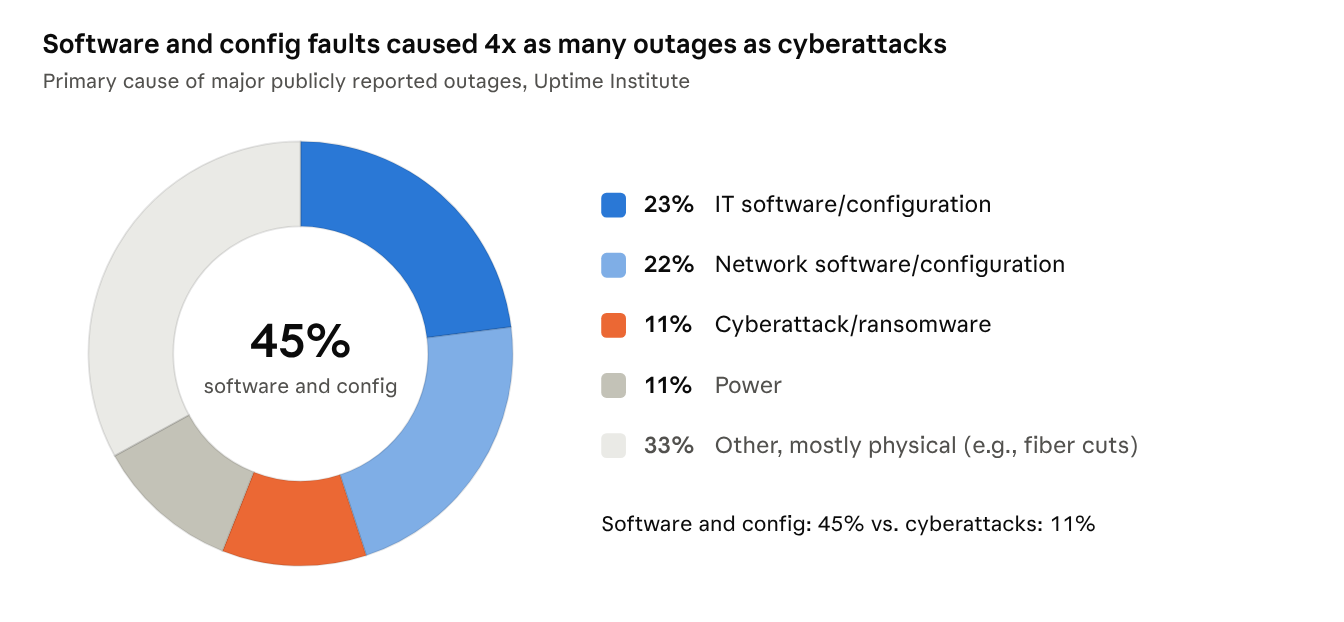
Source: Uptime Institute, Annual Outage Analysis 2024 (as summarized by hi-network). Other causes = remainder. Among major publicly reported outages, software and configuration problems (45%) outnumber cyberattacks (11%) about four to one. Each outage counts once, by its primary cause. The remaining third is mostly physical network failures, such as fiber cuts and broken links. |
|||||||||||||||||||||||||||||||||||
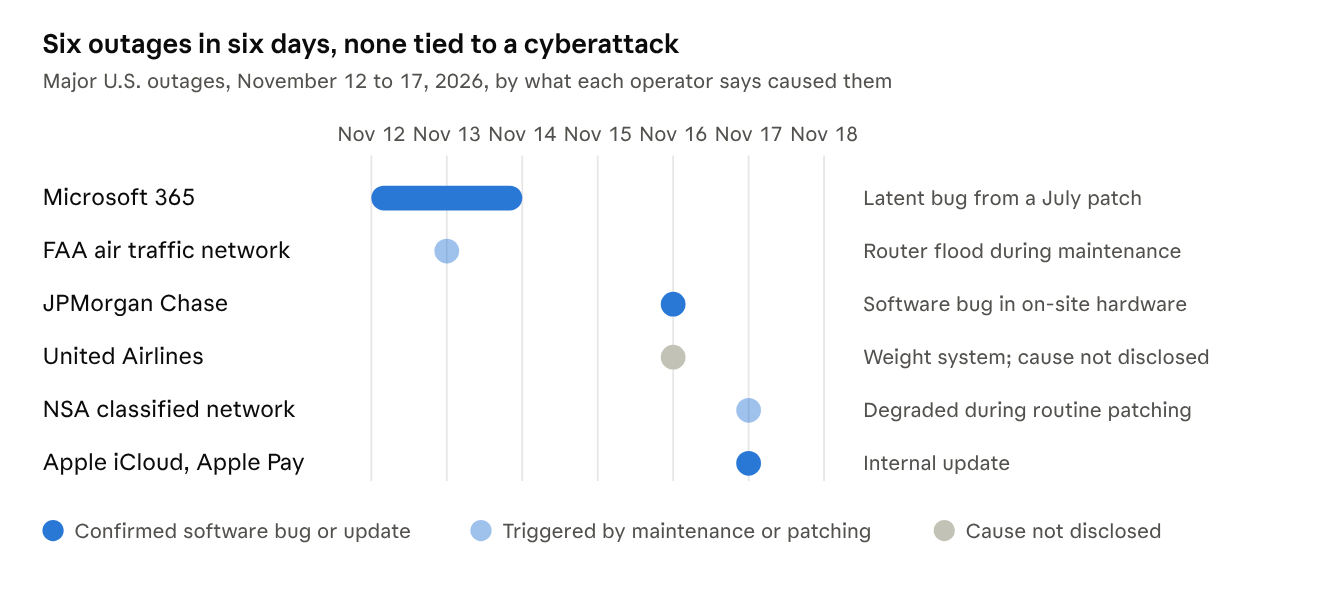
Source: company and agency statements, Nov 12–18, 2026. |
|||||||||||||||||||||||||||||||||||
|
|||||||||||||||||||||||||||||||||||
1. Microsoft 365: a defect that waited four monthsThe outage began around 11:20 a.m. ET on November 12 and took down Outlook, Exchange Online and parts of Teams for roughly a day. Microsoft traced it to a latent defect introduced in a July patch that slipped past testing. It surfaced only when three things lined up at a network gateway: the hidden bug, higher demand and capacity already reduced during an upgrade. More than 80% of the affected servers stopped responding.
Functional root cause: the gateway software could not degrade gracefully under a load-and-capacity combination its testing never exercised. |
|||||||||||||||||||||||||||||||||||
2. The FAA: one router, no containmentThe FAA halted every U.S. departure from late afternoon until 8:15 p.m. ET on November 13, the longest nationwide ground stop since 9/11, and airlines canceled about 12,462 flights. A router installed during copper-to-fiber maintenance at a remote site in El Dorado, Arkansas flooded the agency's legacy telecommunications network with data. Tracing it took about 45 minutes, partly because maintenance is logged on paper. The final root cause is still under investigation.
Functional root cause: the backbone had no way to isolate one device's broadcast traffic, so a local fault spread nationwide. The broadcasting function has since been disabled on about 60 similar routers. |
|||||||||||||||||||||||||||||||||||
3. JPMorgan Chase: a bug in the data centerOn November 16, Chase customers saw delayed transactions and Zelle payments, and customers at other banks felt it whenever a transaction touched Chase. The bank attributed it to a software bug in an on-premise hardware system and said it was not cyber-related. Functional root cause: a defect in software running Chase's own data-center hardware slowed transaction processing, and the delay spread to every institution transacting with Chase. |
|||||||||||||||||||||||||||||||||||
4. United Airlines: no final weights, no departuresThat evening, United held mainline departures for about 90 minutes. A pilots' union memo said the company could not provide outbound flights with final weights, and crew messaging apps were also affected. United has not disclosed the underlying cause but said there was no indication of a cybersecurity issue.
Functional root cause: the weight-and-balance system that every departure depends on stopped producing output. |
|||||||||||||||||||||||||||||||||||
5. The NSA: degradation during patchingOn November 17, NSANet, the agency's classified internal network, went down, and some employees were told to stagger their arrival at Fort Meade. The NSA said it experienced temporary degradation during scheduled routine maintenance; a person familiar with the matter said it happened during routine patching. Functional root cause: a planned change exposed a failure the redundancy design did not absorb. |
|||||||||||||||||||||||||||||||||||
6. Apple: an internal updateAlso on November 17, iCloud, Apple Pay and other services failed that morning. Apple said an internal update caused the outages and that a cyberattack was not involved. Most systems were back by afternoon. Functional root cause: an update introduced a defect into production services. |
|||||||||||||||||||||||||||||||||||
Why software failures clusterHardware wears out on a statistical curve, so its failures really are random. Software doesn't wear out. A defect is a fixed flaw that sits dormant until a specific combination of load, input, configuration or timing reaches it, and then it fails the same way every time. 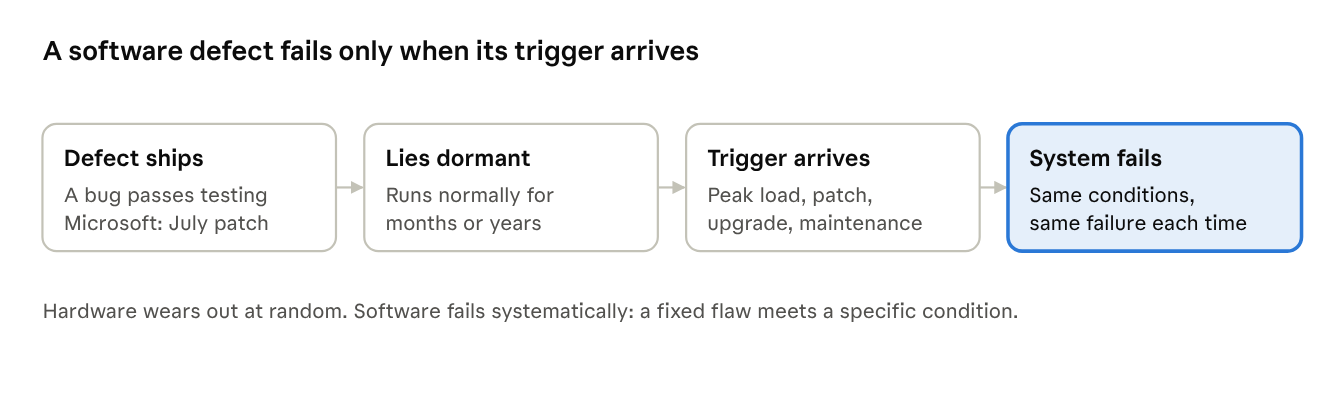
Defects aren't triggered evenly through time. They are set off by events: traffic peaks, patches, upgrades and maintenance windows. When many triggers land close together across a large and growing pool of latent defects, clusters are the expected result, not a sign of sabotage. And the pool keeps growing. U.S. Army and Carnegie Mellon Software Engineering Institute researchers report that software size in aircraft has been doubling about every four years (Boydston, Feiler, Vestal and Lewis). An independent study of more than 400 million lines of code found software systems double roughly every 42 months. 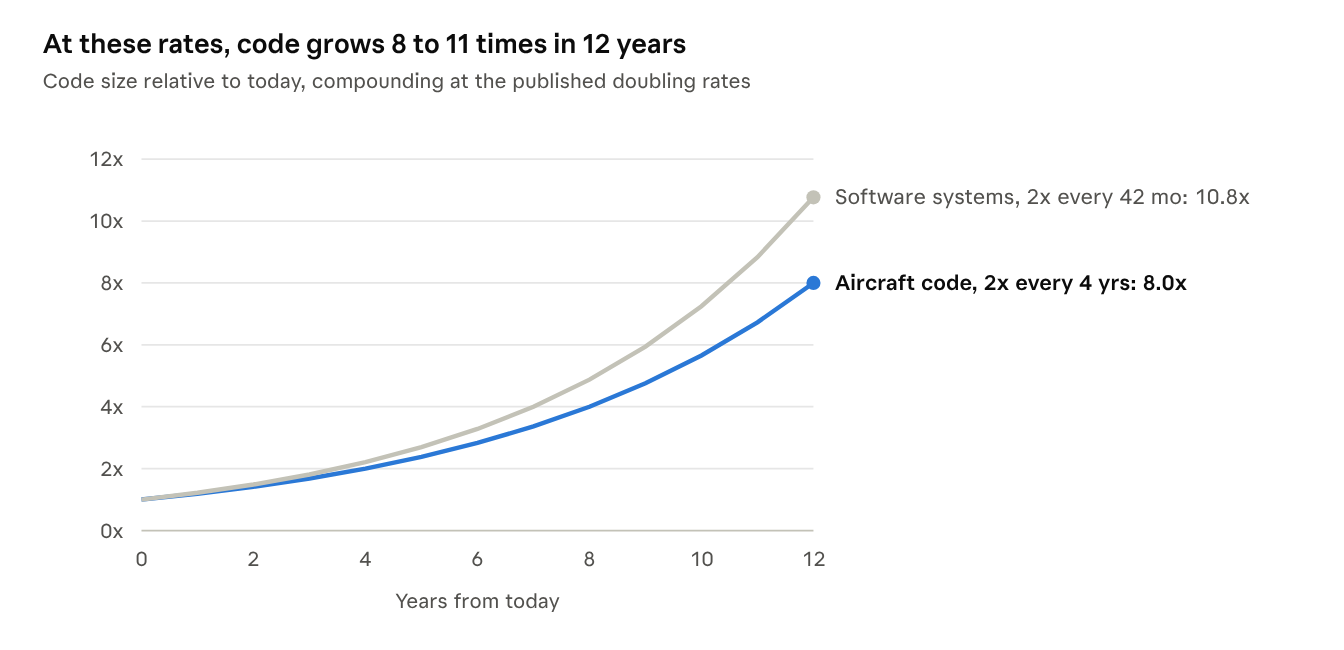
Computed from the doubling rates in Boydston et al. (ACVIP) and Hatton et al. (2017). The benchmark data in Cold Hard Truth About Reliable Software shows that defect density is not going down while size keeps going up. When code doubles and defects per line stay flat, the inventory of latent defects waiting for a trigger doubles with it. |
|||||||||||||||||||||||||||||||||||
Software failures outnumber cyberattacksThe pie at the top counts each major public outage once. A second, separate Uptime Institute survey asked operators what caused their major network outages and let them name more than one cause. 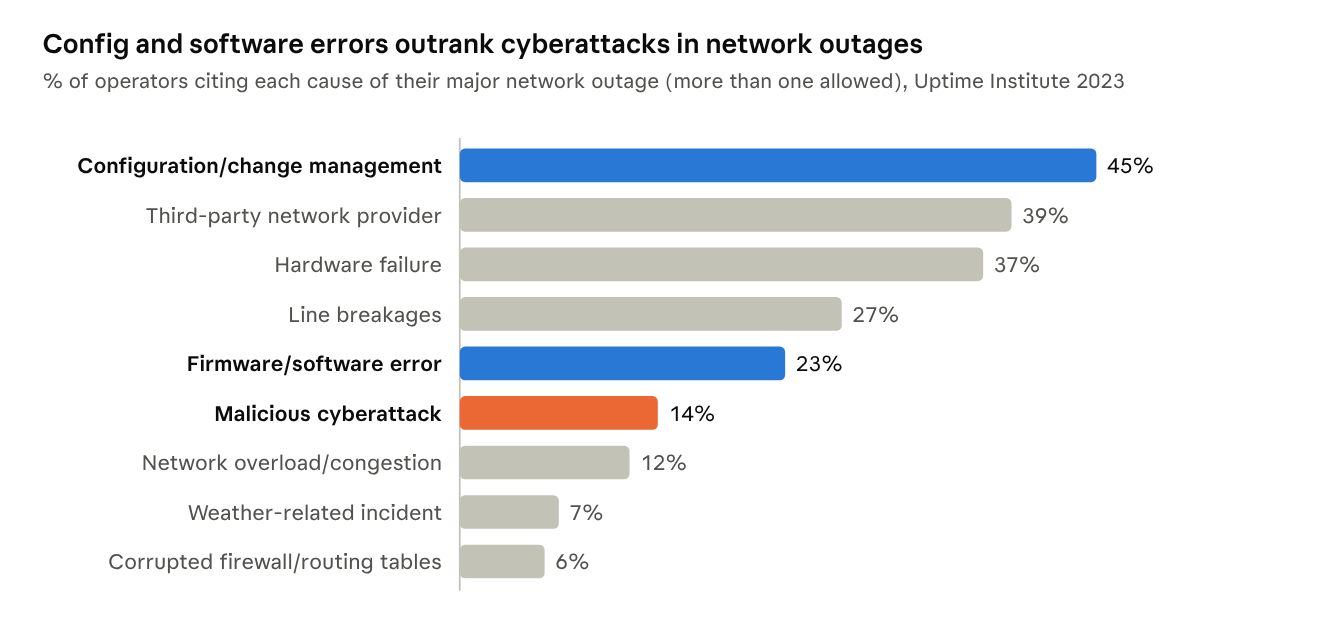
Source: Uptime Institute Annual Outage Analysis 2023, via Network World. Multiple responses allowed. Configuration errors (45%) and software errors (23%) far outrank cyberattacks (14%). The cyber figure is higher than the pie's 11% because this survey covers only network outages and its answers overlap. Uptime's 2026 report adds that firmware and software faults are now the single largest cause of IT system outages. Cyber incidents are fewer but last far longer. Uptime found software and configuration outages averaged about one day of downtime, versus about 25 days for cyberattacks and ransomware. That is why surveys that weigh downtime, such as Splunk's 2024 survey of Global 2000 executives, attribute a bigger share to security incidents. Counted by how often systems fail, software dominates, and six outages that each cleared within hours to about a day fit the software profile. |
|||||||||||||||||||||||||||||||||||
The common threadFive of the six outages came during or right after a change: a patch, an update, an upgrade or a maintenance swap. A senior administration official reportedly said the same, attributing the incidents to upgrades. None was an attack. Each was a latent defect, or a design that couldn't contain one, meeting its trigger. That points to where the effort belongs. Test for the combined conditions that actually occur in production, like Microsoft's high demand on reduced capacity. Roll changes out in stages with tested rollback. Design for containment, so one router can't reach 17 of 22 centers. And read a week like this as a measurement of how many latent defects sit in critical systems, not as a plot. The most likely explanation for this week isn't the most dramatic one. It's software failing systematically, at a scale we've built faster than we've learned to verify. |
|||||||||||||||||||||||||||||||||||
|
|||||||||||||||||||||||||||||||||||
|
|||||||||||||||||||||||||||||||||||
| Predict Earlier. Prevent More. Be Mission Ready. | |||||||||||||||||||||||||||||||||||
|
Sources Forbes, "Outages Plague America: Cyber Attacks Are Not To Blame, Trump Official Reportedly Says" (Nov 18, 2026) · Fox Business and ABC News on Microsoft's root cause · Admiral Markets and AppleScoop outage timelines · Military & Aerospace Electronics, HNGN, Axios, GovInfoSecurity and Business Traveller on the FAA ground stop · AP and Shiftdelete on Chase · CBS News, AP and AvWeb on United · AP and Forbes on the NSA · PBS NewsHour fact check on "90-day blackout" posts · A. Boydston, P. Feiler, S. Vestal, B. Lewis, "Architecture Centric Virtual Integration Process (ACVIP): A Key Component of the DoD Digital Engineering Strategy" · A.M. Neufelder, Cold Hard Truth About Reliable Software, Edition 8 (2026) · Hatton et al., "The long-term growth rate of evolving software," J. Software: Evolution and Process (2017) · Uptime Institute Annual Outage Analysis 2023, 2024 and 2026, and Intelligence Update 350 (March 2025) · Splunk / Oxford Economics, "The Hidden Costs of Downtime" (2024) |
|||||||||||||||||||||||||||||||||||
| © 2026 Mission Ready Software · missionreadysoftware.com |