Reliable Software Risk Assessment
Reliability metrics tell you what already happened. Risk assessment is what tells you what's about to happen. Below are the core elements of tracking the program risks that threaten software reliability.
Why reliability needs its own line on the risk register
Program risk registers often focus on cost and schedule while treating software reliability as a technical detail. This task requires the developer to explicitly identify, score, and mitigate risks — like schedule compression, staffing turnover, or reuse of unproven code — that threaten software reliability specifically.
Reliability risk, named
Risks that threaten software reliability are called out specifically, not buried inside general schedule or cost risk.
Owned and mitigated
Every identified risk has a named owner and a documented mitigation plan, not just a description.
Tied to real data
Risk triggers link back to the plans, development factors, and level of rigor- not just a subjective judgment call. When there's no risk ID, either the big risks stay hidden until they derail the program or people imagine risks that don't exist.
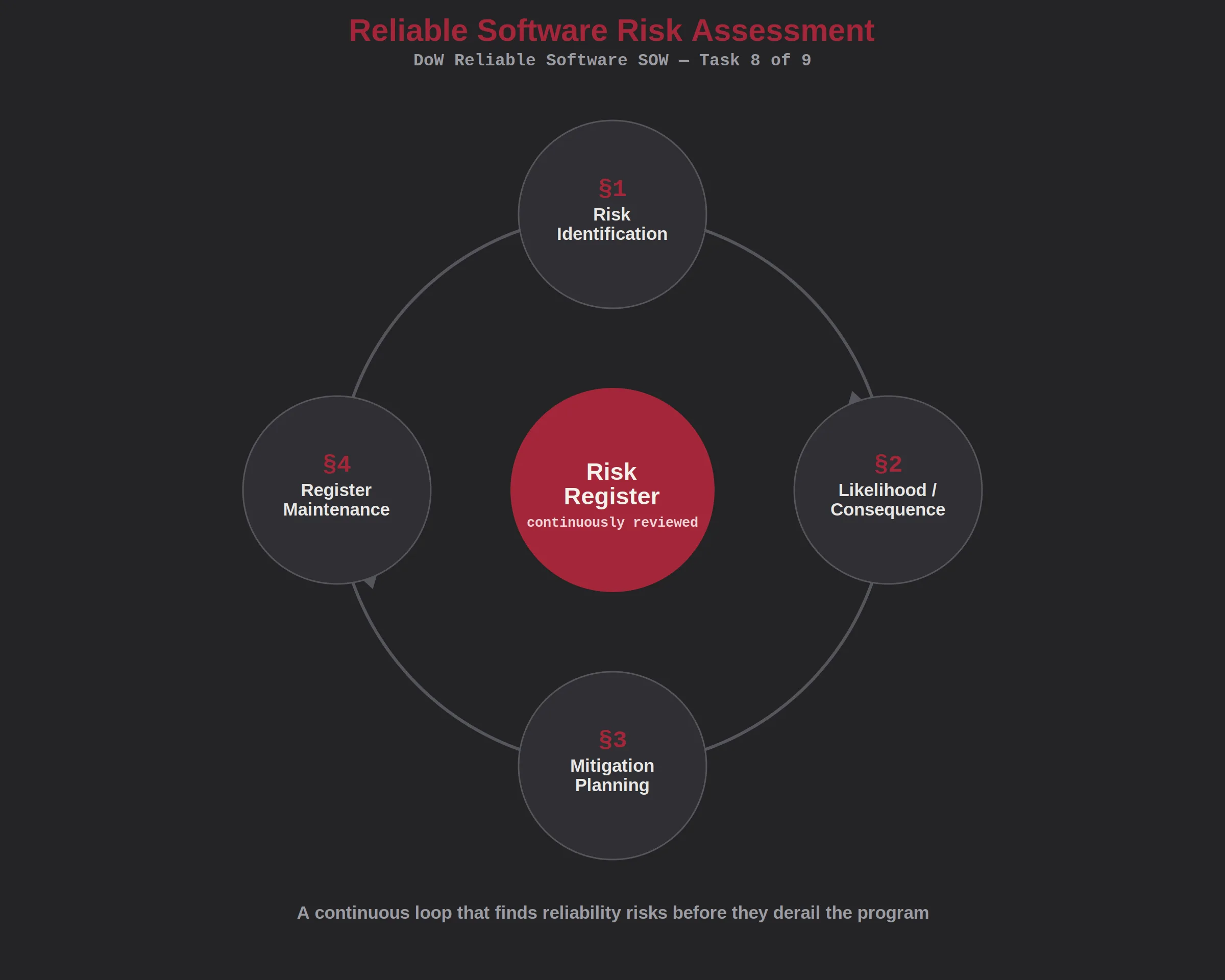
The core elements of reliable software risk assessment
Each element below is a step in identifying, scoring, and managing the program-level risks that threaten software reliability.
Risk Identification
The developer shall identify program risks that could degrade software reliability, including schedule compression, staffing turnover, requirements volatility, and reuse of unproven code.
- Software reliability-specific risks identified separately from general cost/schedule risk
- The IEEE 1633 clause 5.1 lists a few of these risks. Requs AI Risk ID lists the entire spectrum.
- Assess the development factors, management structure, inherent risks, processes, and level of rigor.
- Requs AI Risk ID identifies the risk level in terms of reliability, probability of late delivery and probability of customer satisfaction.
- Risks reviewed and updated as the program situation changes
Likelihood/Consequence Scoring
Each identified risk shall be scored for likelihood and consequence specifically in terms of its reliability impact.
- Scoring scale consistent with the program's overall risk management approach
- Consequence framed in terms of reliability impact, not just cost or schedule
- High-scoring risks prioritized for mitigation planning
Mitigation Planning
Each risk shall have a documented mitigation plan with a named owner and target resolution date.
- Specific, actionable mitigation steps rather than vague intentions
- Named owner accountable for tracking and executing the mitigation
- Target dates tied to the program schedule
Risk Register Maintenance
The reliability risk register shall be maintained and reported at program risk reviews throughout the lifecycle.
- Register updated on a regular cadence, not just at major reviews
- Reliability risks visible alongside cost and schedule risk at program reviews
- Historical record maintained for lessons learned
What proactive risk assessment buys the program
See it coming
Reliability risks are identified and tracked before they turn into missed targets or field failures.
Someone is accountable
Named owners and mitigation plans mean risks get managed instead of just logged and forgotten.
On the program's radar
Reliability risk sits next to cost and schedule risk at program reviews, where decision-makers actually look.
Grounded in real data
Linking risk to evaluation metrics keeps the register from becoming a list of subjective guesses.
Identify if the program will derail from software before any code is written.
Start with the online demo of Requs AI Risk ID or a discussion of your risk assessment approach.