Software reliability prediction software that forecasts RAM metrics early in the program
Machine learning trained on the world's largest root-caused software failure database. Compliant with IEEE 1633 — see how software reliability prediction tools work.
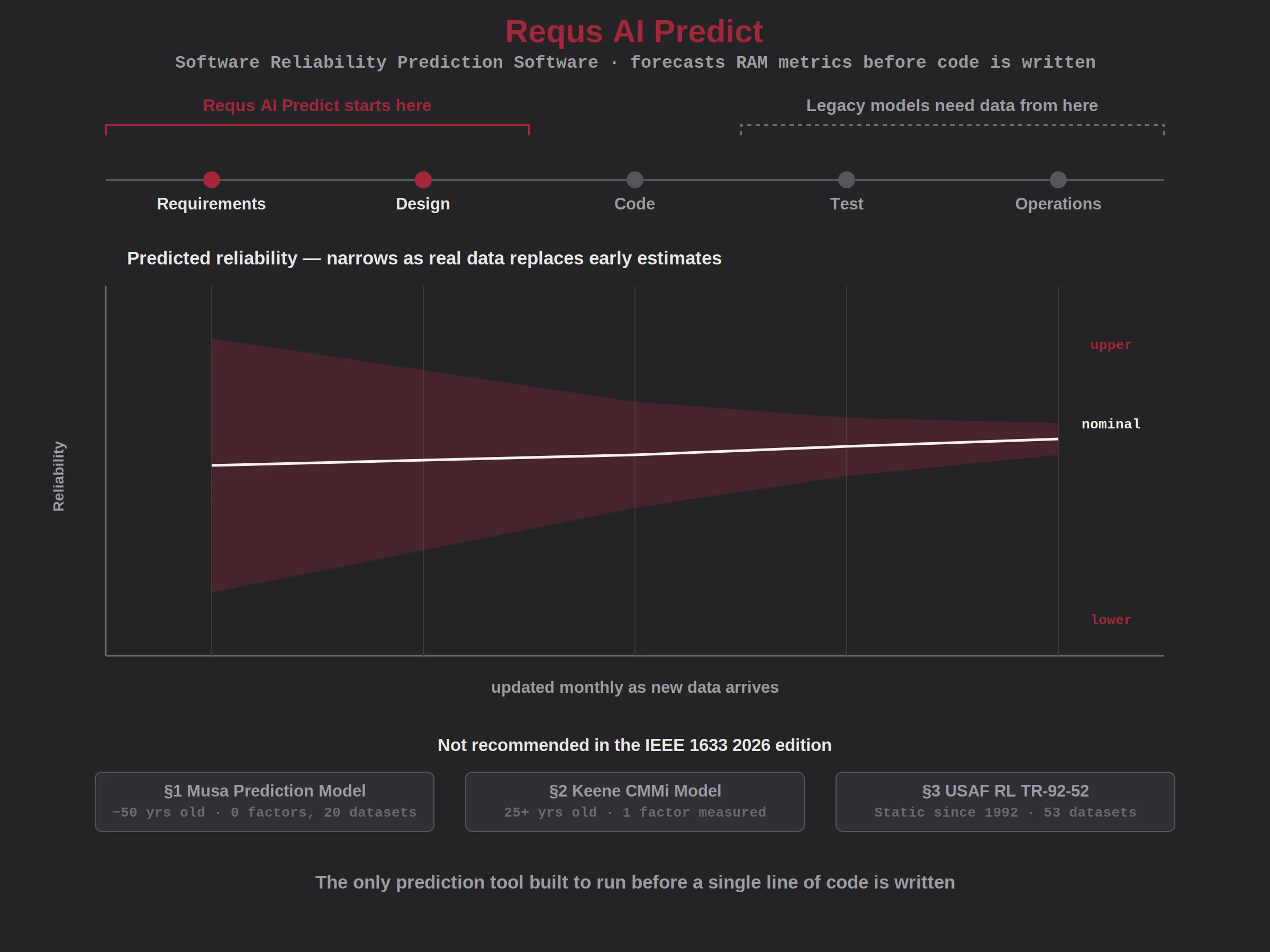
The only true software reliability prediction software on the market that can be used before the code is written.
Because the IEEE 1633 originated from our research and data, Requs AI Predict doesn't just align with these requirements — it is the physical manifestation of them. See how in our whitepaper, Predicting Software Reliability Early.
When your team uses Requs AI Predict, they're utilizing the exact logic expected in these standards.
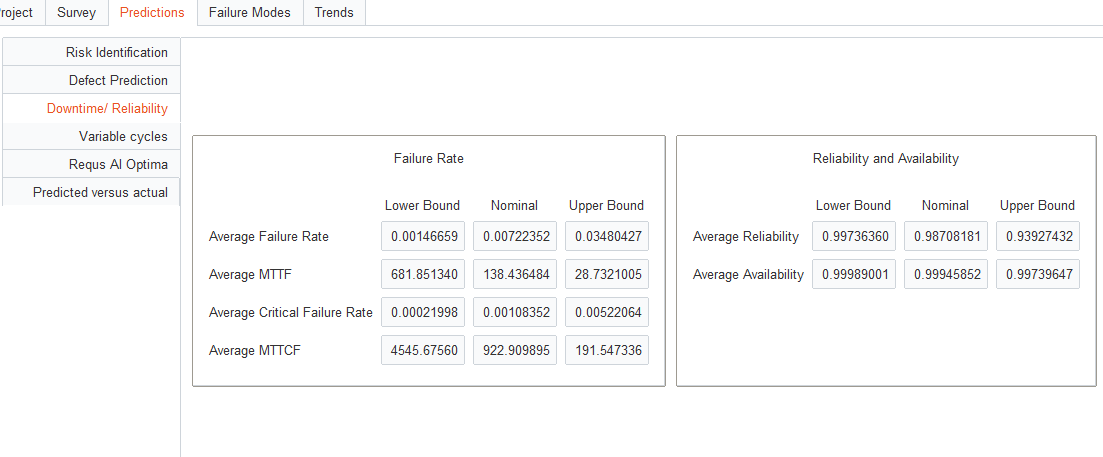
Requs AI Predict output: failure rate, MTTF, critical failure rate, and MTTCF, each with lower bound, nominal, and upper bound estimates — alongside reliability and availability projections.
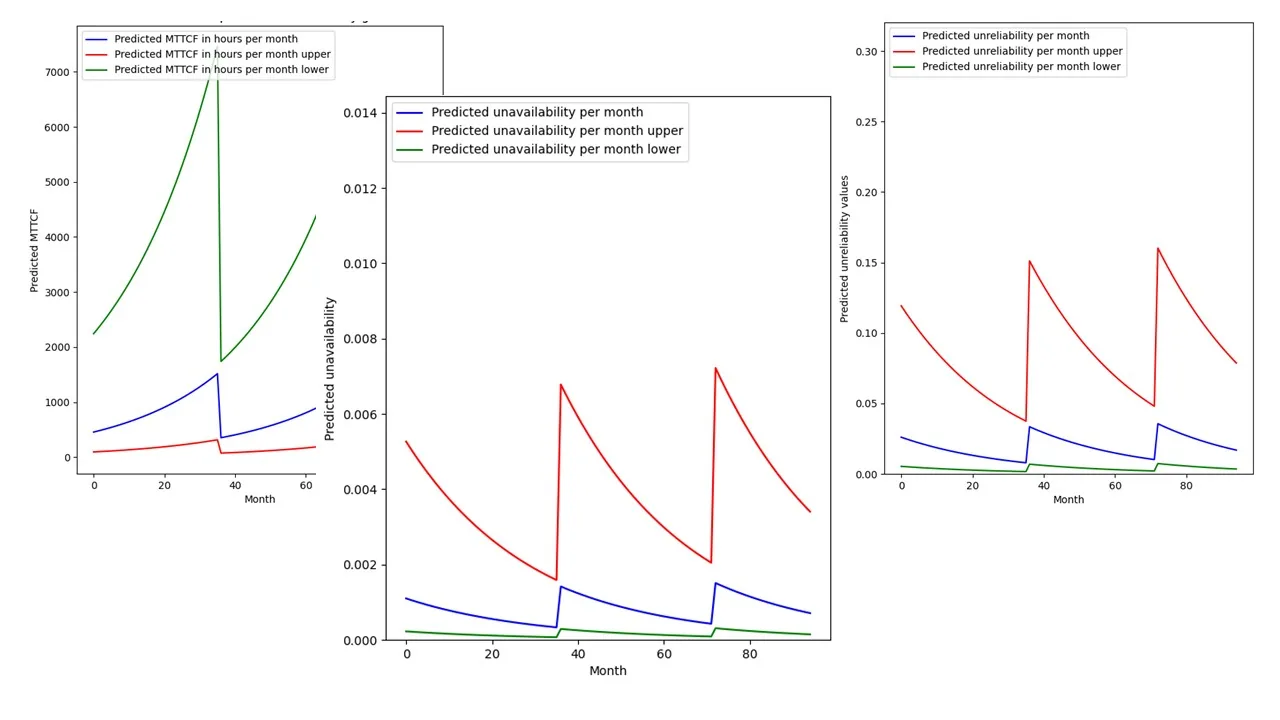
Predicted MTTCF, unavailability, and unreliability trending month over month, with upper and lower bounds shown as the model updates with new data.
Built for efficiency and compliance.
Automated Reporting
Stop manually formatting compliance reports. Requs AI tools are architected to generate the specific deliverables required by international and industry standards
Built-in Best Practices
Your software development lifecycle is pre-aligned with industry standards the moment you begin using our tools.
Collaboration
Supports import/export for multiple team members. "Save as" features provides for an organization wide template.
Keene model, Musa Prediction Model, Rome Laboratory TR-92-52 are not recommended in 2026 edition
Almost 50 years old. Zero factors and 20 sets of data.
The rate at which defects become failures due to processor speed
The rate of software defects becoming failures are due to number of concurrent users and the combined operational profiles.
Over 25 years old. Only 1 factor is measured.
Process capability is all that matters.
Process is necessary but not sufficient. People who understand the end user and industry are key. High quality artifacts over heavy processes.
Hasn't been updated since 1992. Second largest benchmarking study with 53 datasets and 212 factors.
Assumptions and factors are valid but don't include any new methods since 1992.
Requs Ai Predict incorporates the valid factors into our model while also incorporating the modern methods
Software reliability prediction models compared
Not all software reliability models answer the same question. Prediction models work from requirements and process data before code exists; reliability growth models need observed failure data from testing. IEEE 1633 (2026 edition) recommends prediction for early programs and no longer recommends the Keene model, the Musa Prediction Model or Rome Laboratory TR-92-52.
| Model | Type | When it can be used |
|---|---|---|
| Requs AI Predict (IEEE 1633 recommended practice) | Prediction | Requirements and design phase — before code is written |
| Goel-Okumoto model | Growth | During test, once failure data exists |
| Musa basic execution time model | Growth | During test, once failure data exists |
| Musa-Okumoto logarithmic Poisson model | Growth | During test, once failure data exists |
| Jelinski-Moranda model | Growth | During test, once failure data exists |
| Littlewood-Verrall model | Growth | During test, once failure data exists |
| Schneidwind model | Growth | During test, once failure data exists |
| Crow-AMSAA model | Growth | During test, once failure data exists |
| Duane model | Growth | During test, once failure data exists |
| Weibull model | Growth | During test, once failure data exists |
Mature programs use both: prediction to plan, growth models to confirm. See the full set of software reliability growth models and the guide to how prediction tools work.
Get the only recommended software reliability prediction tool.
Start with the online demo or a demonstration.
Predicting Software Reliability Early
Watch a short walkthrough of how this works in practice.
Software Reliability Prediction — Slide Deck
Preview the full slide deck below, or download the PDF to review offline and share with your team.
Requs AI Predict follows the prediction methods in IEEE 1633. For a plain-language walkthrough of the standard, read IEEE 1633 explained.