Software FMEA
A generic FMEA template borrowed from hardware won't surface the failure modes that actually plague software. Below are the core elements of a Software FMEA that finds problems while they're still cheap to fix. Requs AI Software FMEA complies with SAE 1025 FMEA section 7 and the IEEE 1633. It was built for DoW Software FMEA deliverables.
Why software needs its own software failure modes effects analysis, not a borrowed template
Hardware FMEAs are built around physical failure mechanisms like wear, fatigue, and thermal stress. Software fails differently — through requirements gaps, design flaws, and coding defects. A Software FMEA identifies those failure modes explicitly, starting as early as requirements and design.
Starts before code exists
Analysis begins at the requirements and design level, where fixes are cheapest, not after the code is written.
Real failure modes, not templates
Failure modes come from historical software defect data, not a generic checklist copied from hardware. The Common Defect Enumeration is a structured list of historical root causes for failures. It is the basis for the failure modes analysis and fits into the SAE 1025 and IEEE 1633 templates. Requs AI Software FMEA identifies the CDEs that apply to your software and system.
Linked to the bigger picture
Findings are cross-referenced with the system-level FMEA/FMECA so software risk isn't analyzed in isolation. Requs AI Software FMEA identifies the root causes that are dependent on hardware failures as well as the root causes that cause hardware degradation.
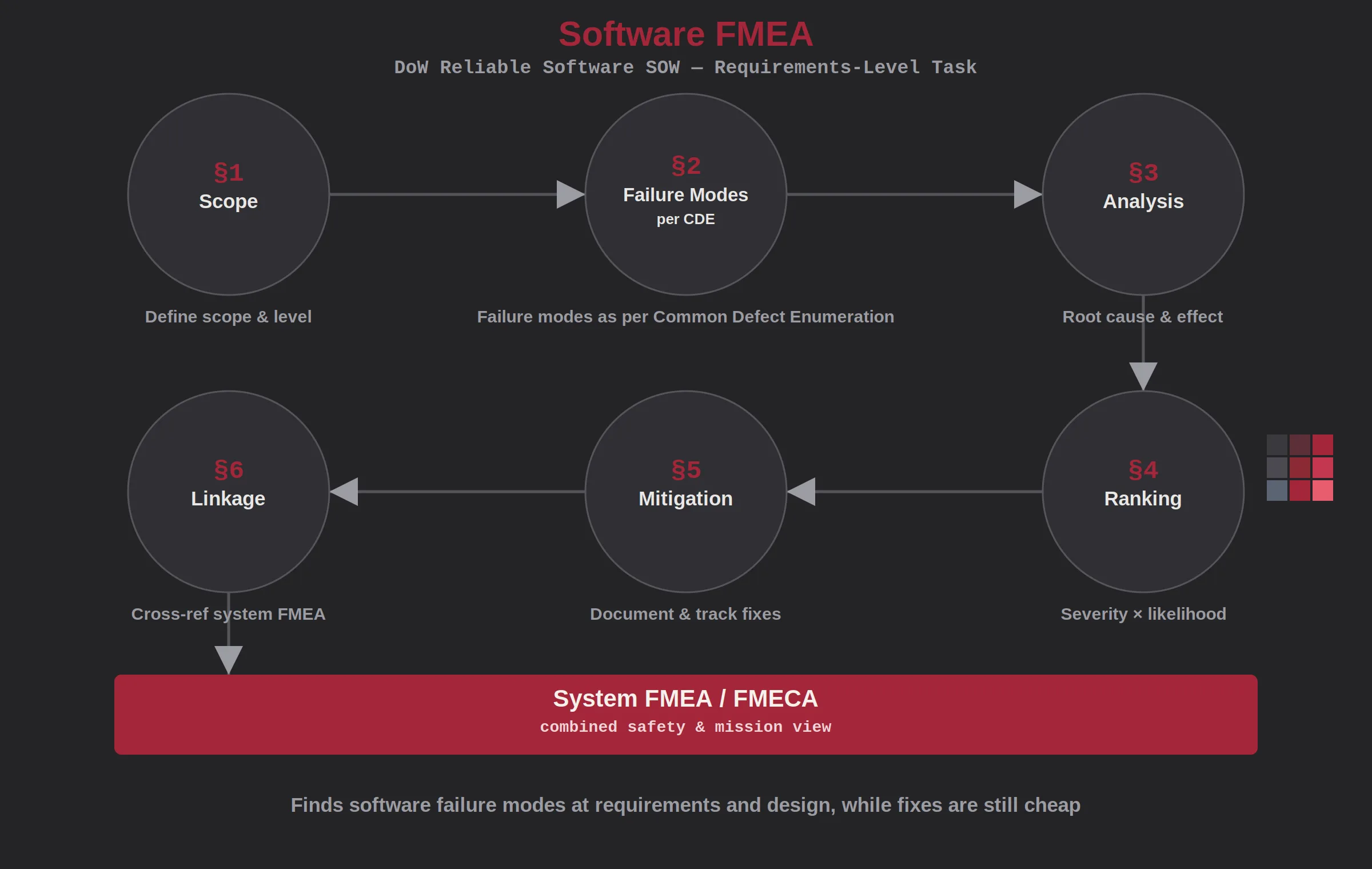
The core elements of Software FMEA
Each element below is a step in performing a Software FMEA that actually reflects how software fails, rather than repurposing a hardware template.
Scope & Level of Analysis
The developer shall define the scope and level of the Software FMEA, e.g., top-level, capability-level, requirements-level
- Scope aligned to what's available at the current lifecycle stage. Requs AI Software FMEA supports the top-level and capability levels, which can be done very early in the design process.
- Detailed FMEAs that focus on code are discouraged since they are expensive, conducted after the code is written and don't uncover expensive design and specification faults.
- FMEAs that focus on "shall statement" must be tailored since they are expensive and only a fraction of defects originate in a single "shall" statement.
- Level of analysis is documented so reviewers know what's covered
- Boundaries are identified.
Failure Mode Identification
Failure modes shall be identified using historical software defect data relevant to the application type, not generic hardware-style templates.
- Failure modes sourced from historical defect and failure data. The Common Defect Enumeration is the recognized source for objective and historically relevant failure modes.
- Modes specific to the software's application domain and architecture. Requs AI Software FMEA automatically filters out the failure modes and root causes that apply to your software and system, dramatically reducing the effort and time required for the analysis.
- Coverage across requirements, design, and interface failure types. Requs AI Software FMEA covers state design models and interfaces between software and hardware, communications, etc.
Cause & Effect Analysis
For each failure mode, the analysis shall identify the root-cause category and the resulting effect at the system level. Requs AI Software FMEA is built on the Common Defect Enumeration which has this built in.
- Root-cause categories: Various root causes related to faulty state management, faulty error handling, faulty processing, faulty timing, faulty sequencing, etc.
- System-level effect of each failure mode traced and documented
- Analysis consistent with the terminology used in the system reliability model
Severity & Risk Ranking
Each failure mode shall be ranked by severity and likelihood to prioritize mitigation effort.
- Severity and likelihood scoring consistent with the program's risk scale. Requs AI Software FMEA allows you to define the program's risk scale.
- Risk priority numbers or equivalent ranking used to sort findings. Requs AI Software FMEA supports both the RPN approach and the risk ranking approach in SAE 1025.
- High-risk items flagged for immediate design attention.
Mitigation & Design Improvement
Recommended mitigations shall be documented and fed back into requirements, design, or test planning.
- Specific, actionable mitigation recommended per high-risk failure mode. Requs AI Software FMEA has built in recommended controls, corrective actions and test cases for each failure mode.
- Mitigations tracked to closure like a corrective action. Requs AI Software FMEA allows you to close out the failure mode once corrected.
- Findings used to inform reliability test planning. Requs AI Software FMEA exports out the tests needed for fault injection.
Linkage to System FMEA
Software FMEA findings shall be cross-referenced with the system-level FMEA/FMECA for consistency and completeness.
- Software failure modes mapped to corresponding system-level effects
- Consistency check against system FMEA severity classifications
- Combined view available for safety and mission-critical assessments. Requs AI Software FMEA is built for simultaneous safety and mission analysis reducing cost.
What a real Software FMEA buys the program
Find it before it fails
Requirements- and design-level analysis catches failure modes while they're still cheap to fix.
Failure modes that actually apply
Data-driven failure modes replace a generic template that would miss how this software actually fails.
Connected to system risk
Cross-referencing with the system FMEA keeps software risk visible to safety and mission-assurance reviews.
A documented rationale
Every mitigation traces back to a specific, ranked failure mode instead of an ad hoc design choice.
Find software's real failure modes before they find your program.
Start with the online demo of Requs AI Software FMEA — the product page includes a feature table and an example worksheet.