AI enabled software balances the software iron triangle before it breaks your program
Requs AI Optima balances the software iron triangle: scope (story points), time (program increment length), cost (corrective actions fixed) and defect reduction.

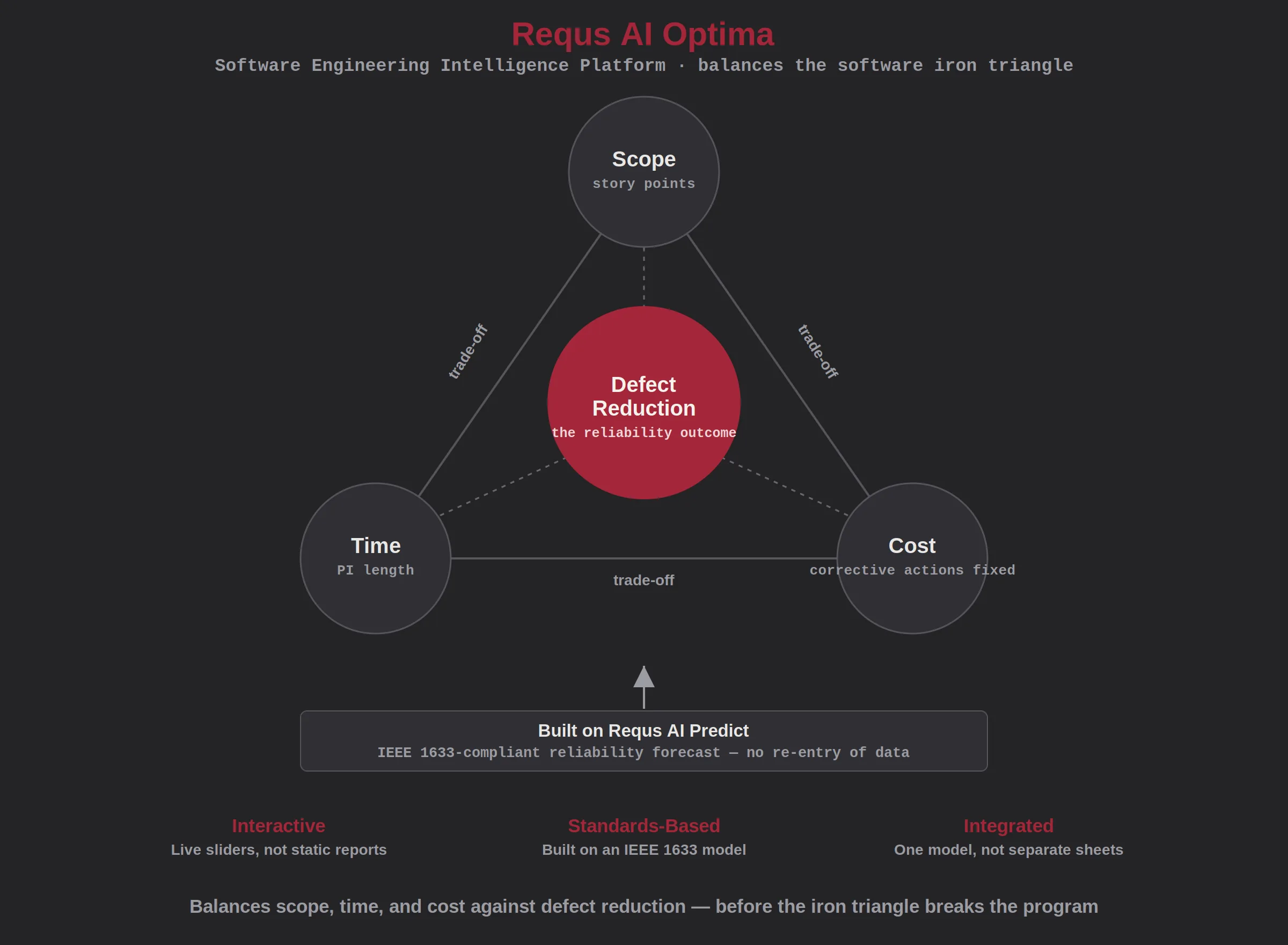
The add-on that turns Requs AI Predict's forecasts into a schedule, scope, and cost plan you can act on.
Requs AI Optima is built as an add-on to Requs AI Predict — it takes the same reliability forecast and runs it forward through the trade-offs every program actually has to make: how much scope to cut, how much schedule to hold, and how much corrective action budget to spend chasing down defects.
Requs AI Optima balances the software iron triangle: scope (story points), time (program increment length), cost (corrective actions fixed) and defect reduction. See how in our whitepaper, Identifying Wasteful Software Development Practices with Predictive AI.
When your team uses Requs AI Optima, they're not guessing at trade-offs — they're seeing the actual predicted effect of each one, updated interactively as inputs change.
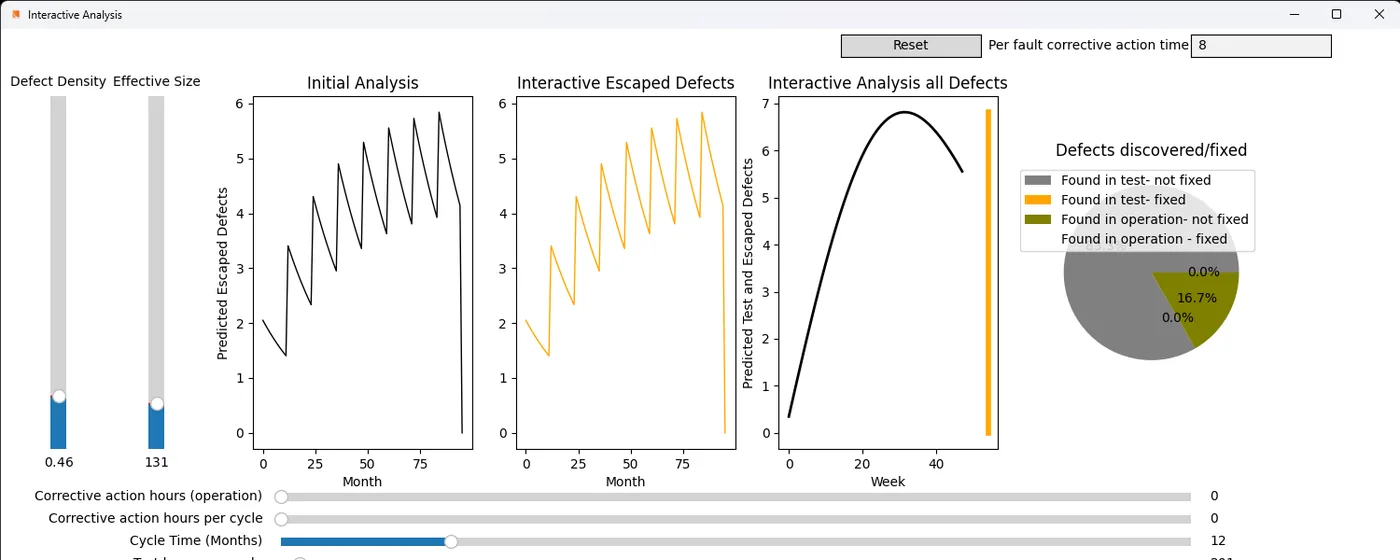
Requs AI Optima's interactive analysis — dragging defect density, effective size, and corrective action time updates predicted escaped defects and the found-versus-fixed breakdown in real time.
Built for efficiency and compliance.
What-If Analysis
Drag a slider and see the predicted effect on escaped defects immediately — no re-running a report or waiting on an analyst.
Built-in Best Practices
Your software development lifecycle is pre-aligned with industry standards the moment you begin using our tools.
Collaboration
Supports import/export for multiple team members. "Save as" features provides for an organization wide template.
Gut-feel trade-offs, fixed schedules, and static spreadsheets aren't recommended in the IEEE 1633 2026
Scope, schedule, and cost decisions are made by feel, not data
An experienced program manager can accurately judge the reliability impact of cutting scope or compressing schedule.
Model the predicted effect of each trade-off against the same reliability forecast used to plan the program.
The schedule is locked and corrective action cost is an afterthought
Holding the schedule fixed and absorbing whatever corrective action cost results is an acceptable trade-off.
Balance program increment length against corrective action budget explicitly, before the schedule is locked.
Trade-off analysis is a spreadsheet that's outdated the day it's built
A one-time spreadsheet analysis is good enough, even as defect density and effective size estimates change.
Use an interactive model that updates predicted escaped defects live as inputs change throughout the program.
Get the only tool that optimizes your software iron triangle.
Start with the online demo or a demonstration.
Identifying Wasteful Software Development Practices — Slide Deck
Preview the full slide deck below, or download the PDF to review offline and share with your team.