FMEA software that does the heavy lifting on software FMEAs
Compliant with SAE 1025 FMEA section 7 and IEEE 1633 clause 5.2.2 — see how it compares with other FMEA software.
The only true software FMEA tool on the market. The others use hardware centric or ineffective approaches.
Because the SAE 1025 FMEA standards and Common Defect Enumeration originated from our research and data, Requs AI Software FMEA doesn't just align with these requirements — it is the physical manifestation of them. See how in our whitepaper, AI-Driven Software FMEA: SAE 1025 & AIAG-VDA Compliance.
When your team uses Requs AI Software FMEA, they're utilizing the exact logic expected in these standards.
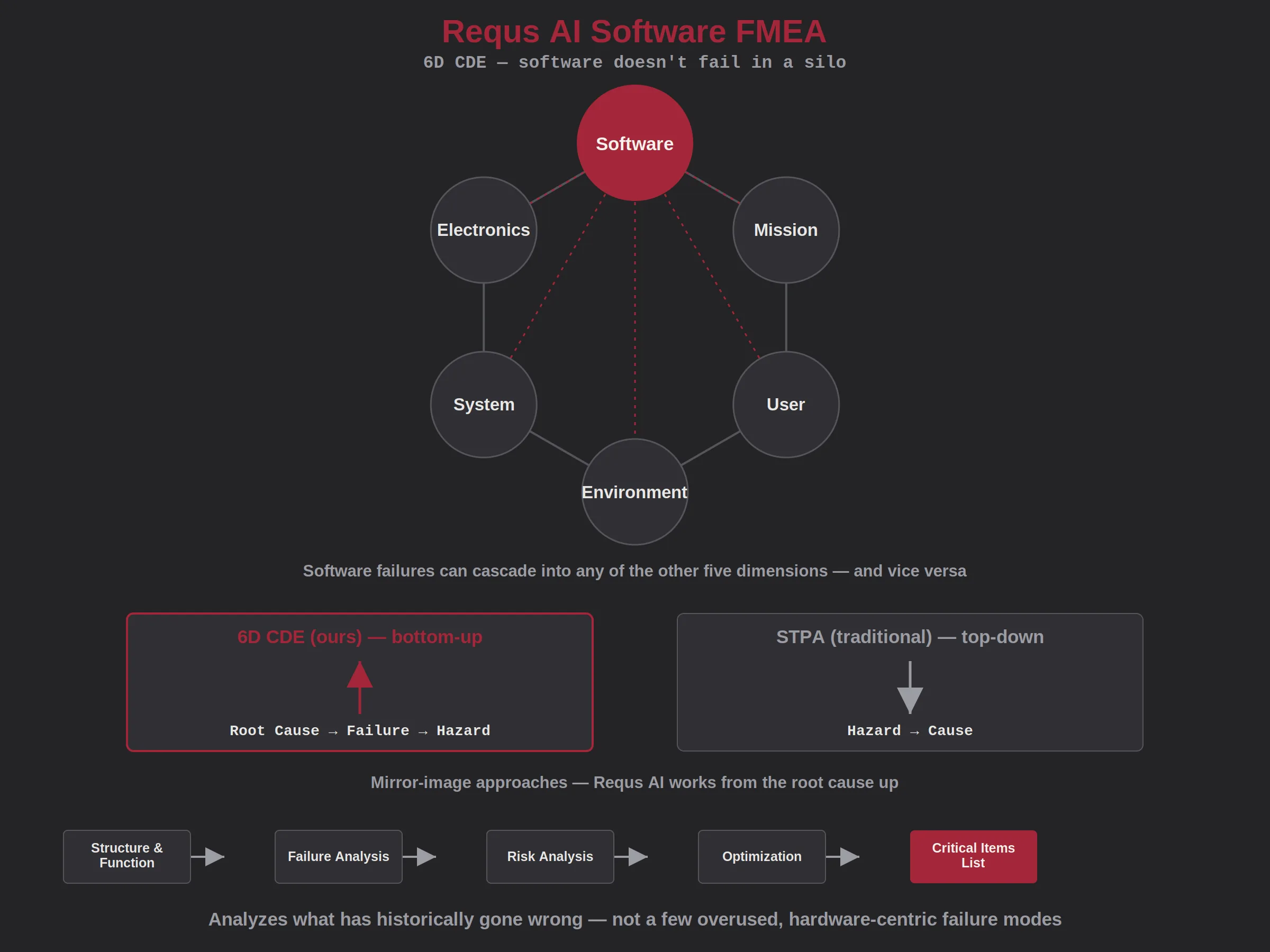
The 6D CDE approach works bottom-up, from root cause to hazard — the mirror image of top-down techniques like STPA. See how the two compare in STPA vs. the 6D CDE Software FMEA.
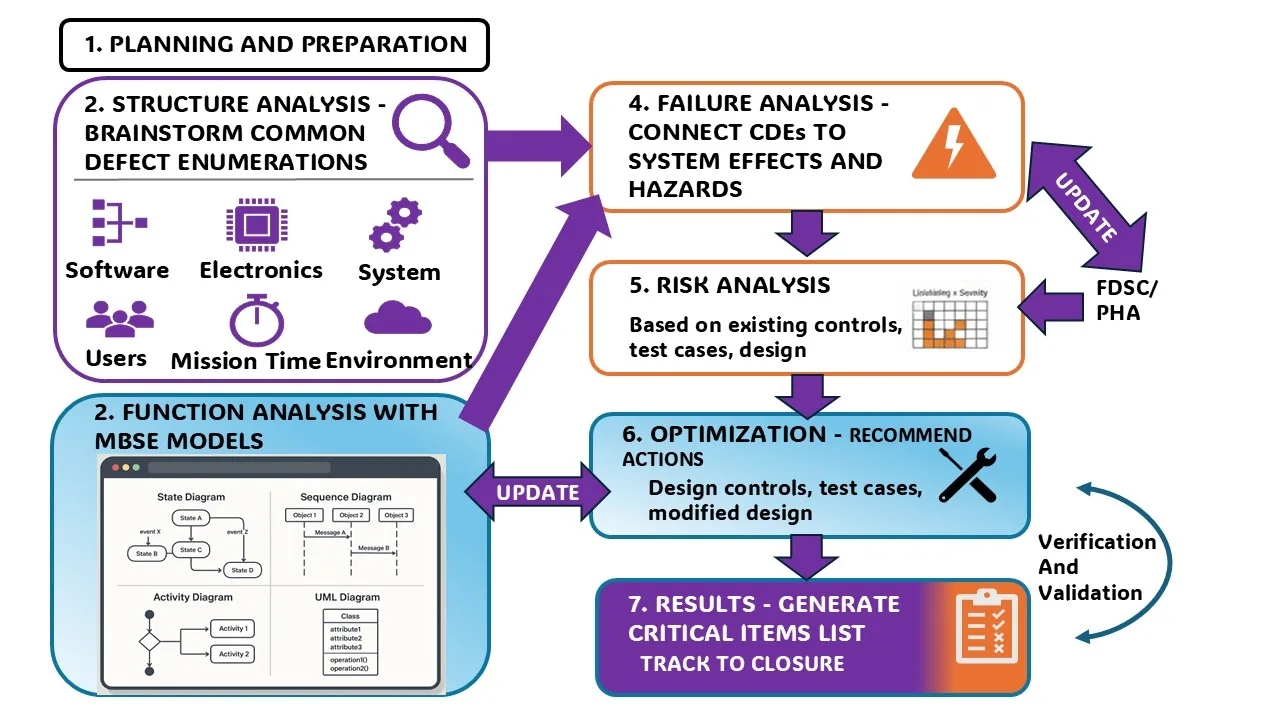
The 7-step 6D CDE Software FMEA process — from structure and function analysis through failure analysis, risk analysis, and optimization to a tracked critical items list.
Built for efficiency and compliance.
Automated Reporting
Stop manually formatting compliance reports. Requs AI tools are architected to generate the specific deliverables required by international and industry standards
Built-in Best Practices
Your software development lifecycle is pre-aligned with industry standards the moment you begin using our tools.
Collaboration
Supports import/export for multiple team members. Supports integrated safety and RAM assessment.
What Requs AI software FMEA does for you
Purpose-built FMEA software for software failure modes — not a hardware tool with a software label.
| Capability | What it does | Standard mapping |
|---|---|---|
| AI failure-mode generation | Identifies software failure modes from requirements, interfaces and design models — before code exists. | IEEE 1633, SAE 1025 §7 |
| Risk ranking | Scores and ranks each failure mode so teams fix the highest-risk items first. | SAE 1025, AIAG-VDA |
| Prepopulated template | Starts from the world's largest software failure database — over a million analyzed documents — instead of a blank sheet. | IEEE 1633 clause 5.4 |
| Automated reporting | Generates the compliance deliverables required by international and industry standards. | SAE 1025 §7, ARP 5580 |
| Team collaboration | Import/export for multifunctional teams; integrated safety and RAM assessment. | AIAG-VDA |
Example software FMEA worksheet
A sample of the analysis Requs AI produces — failure modes, causes, effects and risk ranking in one view.
| Item | Failure mode | Cause | Effect | Risk |
|---|---|---|---|---|
| Sensor input interface | Accepts out-of-range value | Missing bounds check on input | Incorrect control output | High |
| Data processing module | Race condition on shared buffer | Unsynchronized concurrent access | Corrupted data, intermittent fault | High |
| User authentication | Session timeout not enforced | Requirement omitted from specification | Unauthorized access window | Medium |
CSCI/hardware centric, "shall" statement, and detailed viewpoints aren't recommended in the IEEE 1633 2026
CSCIs are analyzed against a few overhyped failure modes
Very few failures originate in the entire CSCI.
Analyze the things that have historically gone wrong across the system, interfaces and design models.
Individual shall statements are analyzed in isolation
A small minority of failures originate in a single shall statement.
Analyze the requirements as a collective whole.
Lines of code or code functions are analyzed
Exhaustively expensive. Only about one third of the failures can be found with this viewpoint.
Analyze the design models, interfaces and specifications before the code is written.
Stop wasting time on FMEA tools that don't really work for software failure modes
Start with the online demo or a demonstration.
AI-Driven Software FMEA — SAE 1025 and AIAG-VDA Compliance
Watch a short walkthrough of how this works in practice.
Software FMEA (SAE 1025) — Slide Deck
Preview the full slide deck below, or download the PDF to review offline and share with your team.