How to design and test for hidden edge cases
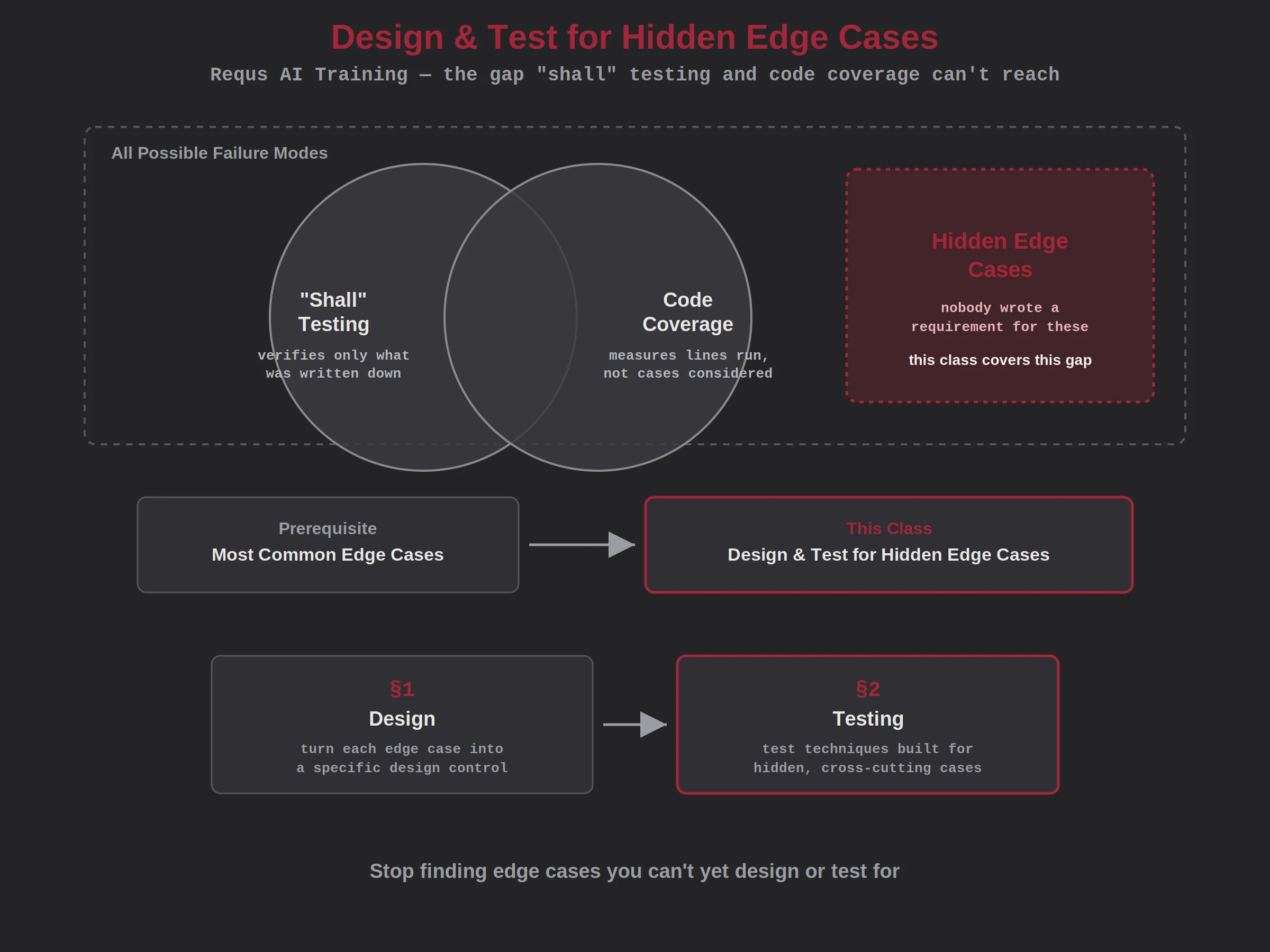
Traditional "shall" testing won't uncover these edge cases. Neither will code coverage tools. This class teaches how to design controls for them — and how to actually test for them.
Knowing the edge case exists isn't the same as catching it
The prerequisite class shows you the hidden edge cases. This class is what to actually do about them. "Shall" testing only verifies requirements that were explicitly stated — it can't test for something nobody wrote down. Code coverage tools only tell you which lines of code executed, not whether the right edge case was ever considered. Both structurally miss the failure modes this class covers.
This class pairs naturally with Requs AI Edge Case — but doesn't require owning it. It's built to be useful on its own.
What the class covers
Two modules, covered in a single self-guided day.
How to design for edge cases
How to translate each hidden edge case from the prerequisite class into a specific design control — the change that actually prevents the failure mode, not just documents it.
An edge case that's recognized but not designed against will still ship. Design controls are what actually close the gap.
How to test edge cases
Test techniques built specifically for hidden edge cases — the kind that "shall" testing and code coverage tools structurally can't uncover, because nobody wrote a requirement for them in the first place.
A design control that's never actually tested is a guess. This module is how you confirm it works before it ships.
Format, duration, and prerequisites
1 Day
Delivered as a single day of self-guided instruction.
Virtual, Self-Guided
Work through the material on your own schedule, at your own pace.
The Most Common Edge Cases
Required before taking this class. Requs AI Edge Case itself is recommended but not required to own.
Stop finding edge cases you can't yet design or test for.
Register for the class, or schedule a demonstration of Requs AI Edge Case.