Software reliability growth models software
Compliant with IEEE 1633
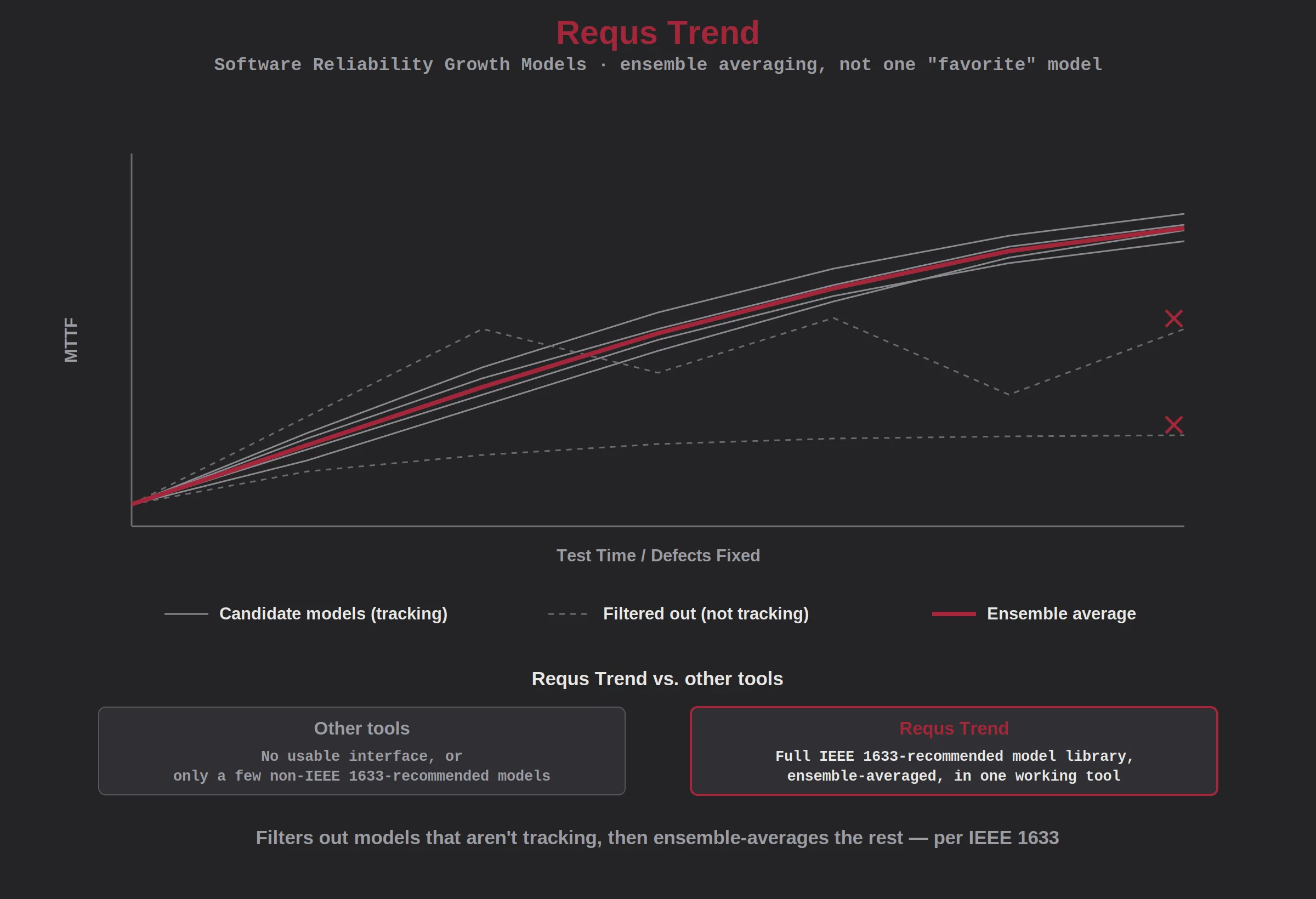
Use this Requs component once you have failure data in testing to forecast software reliability growth models
We built Requs Trend to directly map to IEEE 1633
When your team uses Requs Trend, they're utilizing the exact logic expected in these standards.
Requs Trend is the tool that supports the DoW SOW task Reliable Software Evaluations.
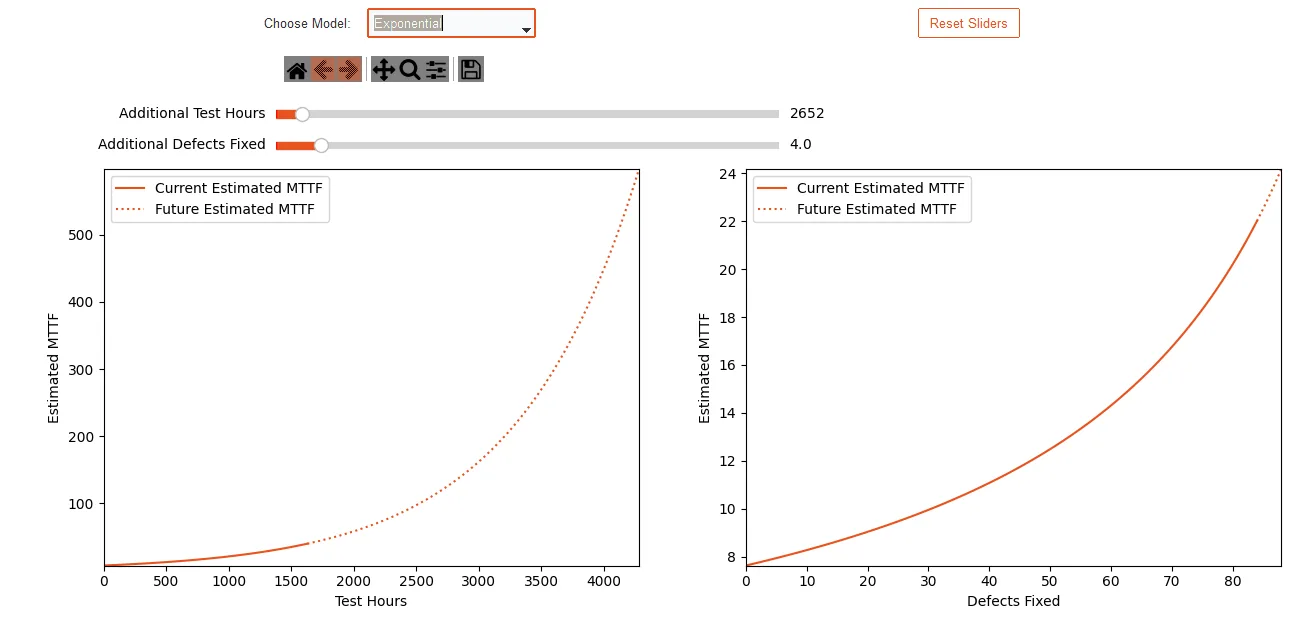
Requs Trend's interactive forecast — drag Additional Test Hours or Additional Defects Fixed to see the current versus future estimated MTTF update instantly, for whichever growth model fits the data.
Three generations of software reliability growth tooling
Most SRGM tools fall into one of three categories: a modern commercial suite built for continuous, enterprise use; actively maintained open-source frameworks built by and for the research community; and legacy tools that were state of the art decades ago but are no longer supported.
Requs Trend
Actively maintained commercial platform and the only tool that fully supports IEEE 1633-recommended growth models, applying ensemble averaging across the model set.
STAR
STAR automates multi-curve fitting on a cloud SaaS platform, but its model library is not aligned with IEEE 1633 and does not provide standards-based model selection.
C-SFRAT, SFRAT, SweET
Actively maintained academic and research tools offering free access to a range of classic and modern growth models.
CASRE, SMERFS, SRMP
Historically significant tools, no longer updated or supported, best suited to replicating older studies or archival baselines.
Requs Trend compared to seven other software reliability growth model tools
Every tool below is evaluated on the same four dimensions: current support status, the underlying framework, what makes it distinct, and where it fits best.
Requs Trend
Active / Commercial Suite
Proprietary Enterprise Dashboard
Continuous validation of pre-code defect density baselines against real-time test execution data.
Regulated enterprise or defense applications matching code testing to strict IEEE 1633 compliance.
| Tool | Status & Support | Primary Framework | Key Distinguishing Feature | Best Used For |
|---|---|---|---|---|
| Requs Trend | Active / Commercial | Desktop, Named user off premise cloud, Named user on premise cloud | Provides a wide array of models, selects and ranks the models, and ensemble averages the relevant models. Handles imperfect and changing test hours data. | Covers the recommended software reliability growth models from IEEE 1633. Covers Agile test environments in addition Waterfall. |
| C-SFRAT | Active / Open Source | Python 3 Framework | Factors in changing test intensity and covariate external activity adjustments (e.g., changing staff or hours). | Complex, non-uniform modern Agile or DevOps testing environments with variable testing efforts. |
| SFRAT | Active / Open Source | R / Shiny Web Interface | Quick, browser-based curve fitting for traditional failure counting models. | Rapid graphical validation and analysis of testing data logs without running local command-line code. |
| SweET | Active / Open Source | MATLAB & Web App Platform | Employs Weibull defect injection and phase-based expectation models. | Academic research and teams tracking structured defect removal trends across distinct dev phases. |
| STAR | Active / Commercial | Cloud-Based SaaS Platform | Graphical user interface visualizes curves but the models aren't recommended in the IEEE 1633. | Models can be vetted by the user but the models aren't recommended in the IEEE 1633. |
| CASRE | Outdated / Unsupported | Legacy Windows (16/32-bit GUI) | Originally developed by NASA/JPL; wraps older statistical code in a basic, legacy menu interface. | Replicating historical aerospace reliability research datasets using classic NHPP models. |
| SMERFS | Outdated / Unsupported | Command-Line / DOS Executable | Text-only configuration; executes rigid goodness-of-fit verifications on raw execution-time or interval inputs. | Archival baseline calculations where modern graphical interfaces or covariate variables are not required. |
| SRMP | Outdated / Unsupported | Standalone Legacy Software | Simultaneously runs up to nine specific early statistical growth models using maximum likelihood estimations. | Historical baseline auditing of mission-critical systems built on legacy codebase structures. |
Built for efficiency and compliance.
Automated Reporting
Stop manually formatting compliance reports. Requs tools are architected to generate the specific deliverables required by international and industry standards
Built-in Best Practices
Your software development lifecycle is pre-aligned with industry standards the moment you begin using our tools.
Not a research project
Unlike CASRE, SMERFS, and SRMP, Requs Trend is actively maintained and commercially supported — no dead links, no unsupported legacy binaries.
Real-time, not batch
Requs Trend continuously validates defect density baselines against live test execution data, rather than a one-time curve fit run after the fact.
Built for IEEE 1633
Purpose-built for regulated and defense programs that need to demonstrate strict compliance with IEEE 1633, not adapted from an academic tool.
Starts before the code does
Where most SRGM tools only analyze failure data collected during test, Requs Trend anchors its baseline in pre-code defect density predictions.
A few software reliability growth models
Here are a few software reliability growth models: Musa Basic Execution Time Model, Musa-Okumoto Logarithmic Poisson Model, Weibull, Rayleigh, Jelinski-Moranda NHPP, Goel-Okumoto, Schneidwind, Shooman, Duane, Crow-AMSAA, Yamada Delayed S-Shaped Model, Ohba Inflection S-Shaped Model, Moranda Geometric Model, and Littlewood-Verrall Model.
Get the common sense software reliability growth models tool.
Start with the online demo or a demonstration.
Software Reliability Growth Models — Slide Deck
Preview the full slide deck below, or download the PDF to review offline and share with your team.