The Reliable Software Program Plan
The Reliable Software Program Plan (RSPP) is the foundation task of the Reliable Software SOW — it is the document that turns the other eight tasks into a scheduled, staffed, and resourced program rather than a list of good intentions. Below are the core elements a compliant RSPP should contain.
Mission Ready Software has pre-built reliability software program plan templates. We can help you tailor them.
Why the Program Plan comes first
Without a Reliable Software Program Plan, tasks like FRACAS, allocation, prediction, and testing tend to happen late, inconsistently, or not at all. The RSPP is where the developer commits — on paper, on contract — to who does the reliability work, when it happens, what data and tools are used, and how success is measured.
Sets up every other task
Schedules, staffs, and resources the remaining eight Reliable Software SOW tasks so they are executable, not aspirational.
Gives the customer visibility
Provides the government program office a single artifact to assess whether software reliability is actually being engineered in.
Evolves with the program
Updated at each milestone as the architecture, schedule, staffing, and risk posture change.
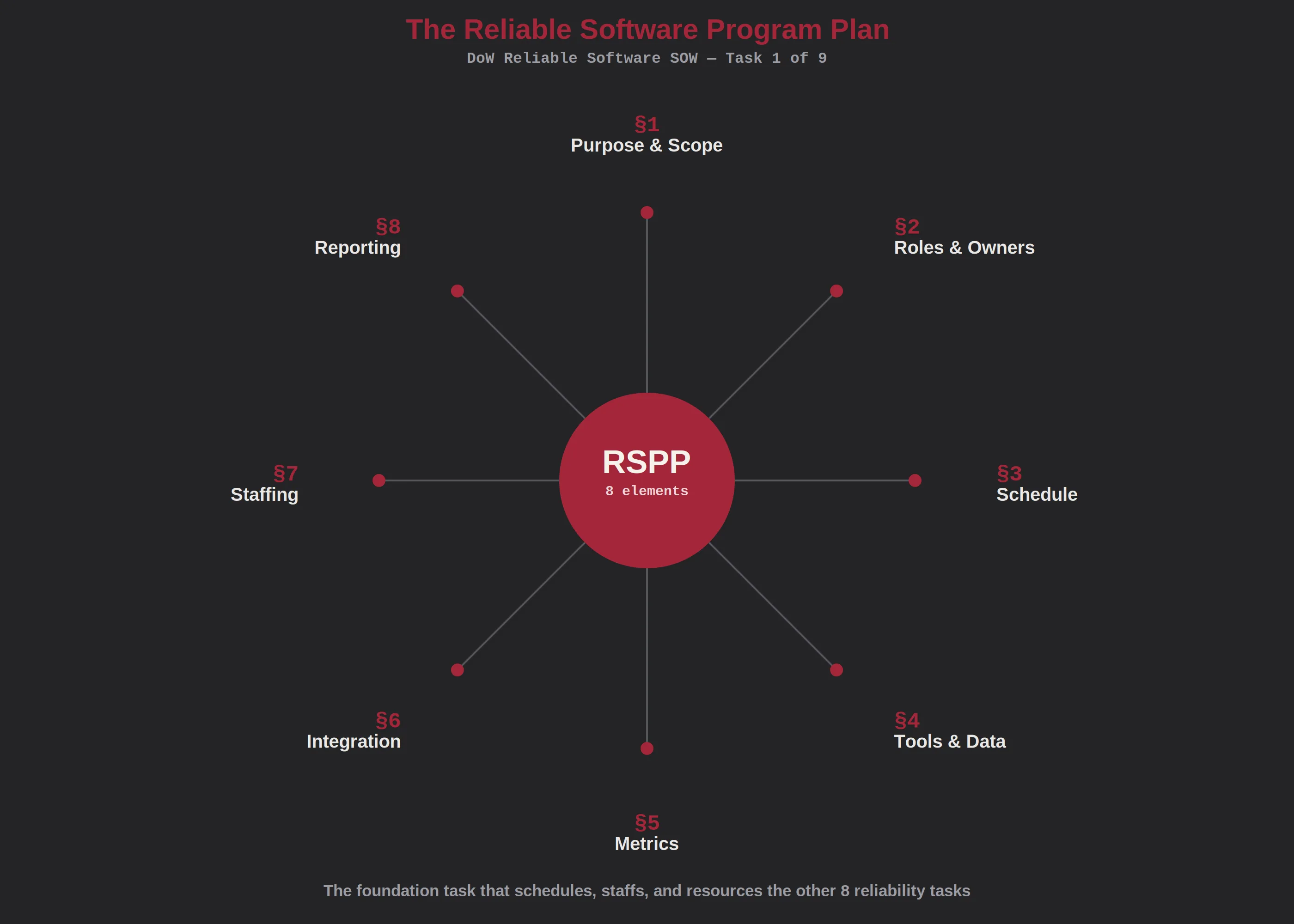
The core elements of the Reliable Software Program Plan
Each element below is a section the RSPP should contain, establishing how the developer will plan, staff, and execute reliable software engineering across the program.
Purpose and Scope
The reliable software program plan shall state its purpose, the systems/CSCIs it covers, and how it relates to the overall Software Development Plan (SDP) and Systems Engineering Plan (SEP).
- Applicable contract, program, and system boundaries
- Relationship to the SDP, SEP, and Reliability Program Plan
- Definitions and acronyms used consistently across the other 8 tasks
Organization and Responsibilities
The plan shall identify who is responsible for each reliability task, their authority, and how they interface with software engineering, systems engineering, and program management.
- Named or role-based ownership of FRACAS, FMEA, prediction, and test tasks
- Reporting chain to program management and the customer
- Interfaces with independent V&V, safety, and quality organizations
Reliability Task Schedule & Milestones
The plan shall schedule each of the 9 Reliable Software SOW tasks against the program's Integrated Master Schedule (IMS) and technical review milestones.
- Task start/complete dates tied to SRR, PDR, CDR, TRR, and test events
- Dependencies between tasks (e.g., allocation before prediction)
- Deliverable due dates for each reliability work product
Tools, Standards & Data Sources
The plan shall identify the standards, models, tools, and historical data sources used to execute FRACAS, FMEA, prediction, and test tasks.
- Governing standards (e.g., IEEE 1633) and internal procedures
- Reliability prediction and FRACAS tooling
- Historical defect and failure-rate data sources by application type
Metrics & Entry/Exit Criteria
The plan shall define the metrics collected for each task and the entry/exit criteria used to judge whether a task is satisfactorily complete at each milestone.
- Defect density, failure rate, MTBSF, and reliability growth metrics
- Pass/fail or maturity thresholds at each technical review
- Escalation path when the key RAM metric isn't trending towards the goal
Integration with Other Program Plans
The plan shall describe how reliable software tasks are integrated with the SDP, Test & Evaluation Master Plan (TEMP), Risk Management Plan, and system-level reliability program.
- Cross-references to related plans rather than duplicated content
- Shared data flow between FRACAS, risk register, and system reliability model
- Single reliability picture spanning hardware and software
Training & Staffing Plan
The plan shall identify the staffing level and reliability-engineering competency needed to execute the plan, including any required training.
- Required experience/qualifications for reliability task owners
- Training on the governing standard and internal tools
- Staffing profile across the program lifecycle
Reporting, Reviews & Plan Maintenance
The plan shall define how reliability status is reported at technical reviews and how the RSPP itself is kept current as the program evolves.
- Reliability status briefed at SRR, PDR, CDR, TRR, and risk reviews
- Revision history and update triggers (e.g., major design change)
- Customer review/approval process for plan updates
What a well-executed Reliable Software Program Plan buys the program
Turns tasks into a plan
FRACAS, FMEA, prediction, and test stop being aspirational SOW language and become scheduled, staffed, resourced work.
One place to check status
Program management and the customer can see, at a glance, whether reliability tasks are on track at each milestone.
Common tools and data
Standardized standards, tools, and historical data sources keep every reliability task speaking the same language.
Keeps pace with the program
Because it is a living, reviewed document, the plan evolves as the design, schedule, and risk picture change.
Give the program a Reliable Software Program Plan it can actually execute. Start with our RSPP template.
Start with a discussion of your RSPP requirements.