The Certified Reliability Engineer — Software
A two-exam credential for engineers who work in software reliability. One exam covers general software reliability engineering knowledge; the other covers software FMEA specifically, built around the Common Defect Enumeration and a systems viewpoint across six dimensions of failure. Each exam is issued upon successful completion of its associated training course.
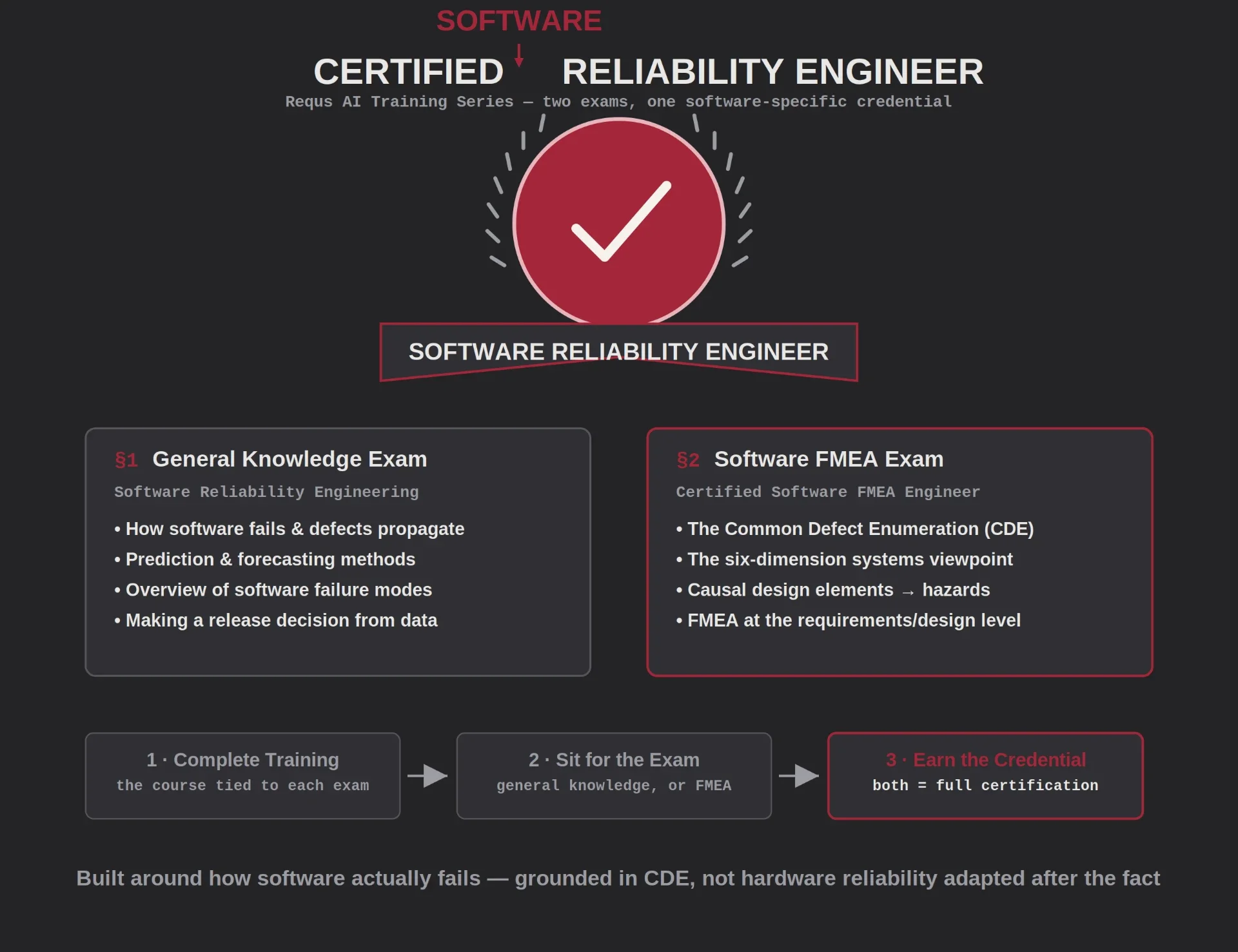
Two exams, two distinct areas of competence
The certification is organized around two separate exams, each tied to its own training course. Together, they validate both a broad working knowledge of software reliability engineering and a deep, practical competence in software FMEA specifically.
General Software Reliability Knowledge
Covers how software fails, prediction and forecasting methods, software failure modes, and how to make a release decision from reliability data.
Software FMEA
Covers the Common Defect Enumeration and a systems viewpoint across the six dimensions of failure, applied through software FMEA.
Course Completion Gated
Each exam is provided only upon successful completion of its associated software reliability and/or software FMEA training course.
What each exam covers
Each exam maps directly to its own training course and tests a distinct, practical area of software reliability competence.
Software Reliability Engineering Exam
Tests a broad, practical understanding of software reliability engineering — how software fails, how to forecast that failure, and how to act on the results before release.
- How software fails, including common failure mechanisms and defect propagation
- Methods for predicting and forecasting software reliability
- An overview of software failure modes
- How to make a release decision based on reliability data
Certified Software FMEA Engineer Exam
Tests practical competence in performing a software FMEA using the Common Defect Enumeration and a systems-level viewpoint, rather than a hardware-centric or code-level approach.
- The Common Defect Enumeration (CDE) taxonomy
- The systems viewpoint across the six dimensions of failure
- Connecting causal design elements to system effects and hazards
- Applying software FMEA at the requirements and design level
Each credential follows its training course
Complete the Training Course
Take the software reliability engineering course, the software FMEA course, or both, depending on which credential you're working toward.
Sit for the Associated Exam
Each course concludes with the exam that covers its material — general software reliability knowledge, or software FMEA specifically.
Earn the Credential
Pass each exam to earn that credential. Completing both exams earns the full Certified Reliability Engineer — Software designation.
Why a software-specific credential, not a general one
Built around how software actually fails
Rather than a general reliability engineering credential with software as an afterthought, both exams are built specifically around software failure behavior.
Tied to hands-on training, not just a test
Each exam is only available after completing its training course, so the credential reflects applied instruction, not just self-study for a test.
General knowledge and FMEA, separately validated
Broad software reliability literacy and deep software FMEA competence are tested and credentialed separately, so each can be earned and recognized on its own.
Grounded in CDE and the six-dimension viewpoint
The software FMEA exam is built on the same Common Defect Enumeration and 6D systems viewpoint used throughout the Requs AI Software FMEA methodology.
Get your team credentialed in software reliability and software FMEA.
Start with a discussion of the associated training courses.